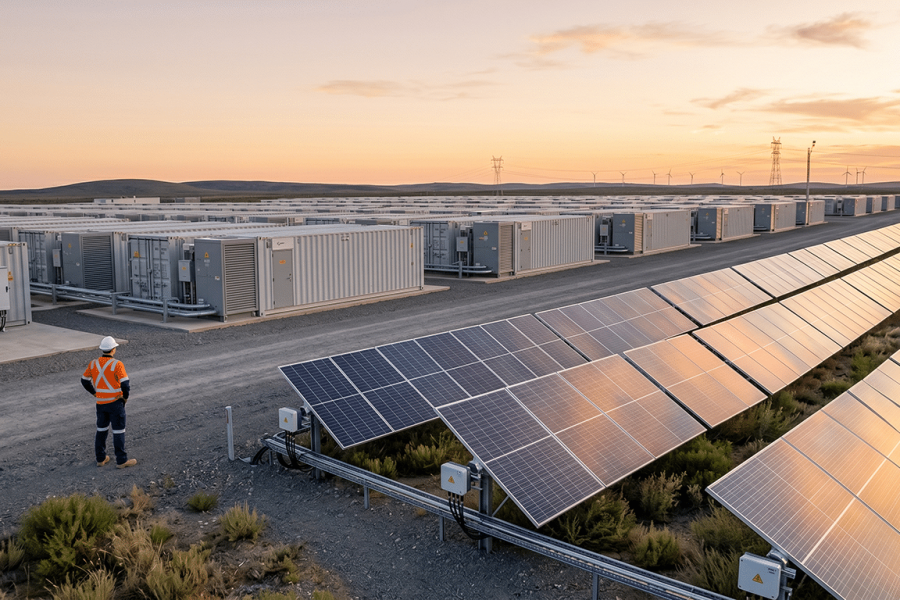

Innovate UK has reopened its ultra long duration energy storage competition, with grants of up to £700,000 for UK businesses developing electrochemical storage that can run for 100 hours or more.
The competition sits inside the UKRI R&D Missions Accelerator Programme and there is up to £3 million available in this first phase. It funds project development studies, so what you are being paid to produce is the engineering design, costing and planning that gets a real storage system ready to build, rather than the build itself. A second phase worth at least £10 million is planned for mid-2027 to back the demonstrators that come out of it.
Below, I have explained the key things you need to know about this competition before you apply: who is eligible, how much funding is on the table, and what the application process looks like.
Find Out if You're Eligible Now
To find out if you and your project are suitable for this grant, book in a free Competitiveness and Eligibility Assessment. In just 25 minutes, I'll tell you:
- Whether you're a strong candidate for this competition
- Other grants you may be eligible for
- What other sources of funding we can help you secure

Never Miss a Funding Opportunity
New grant competitions are opening all the time. Make sure you don’t miss out by subscribing to GrantTree’s newsletter.
Who is Eligible?
Your Organisation
To lead a collaborative project or work alone, you must be a UK registered business of any size. Academic institutions can't lead or work alone in this competition.
You can be a micro, small or medium-sized enterprise or a large business. SMEs can apply as a sole applicant or lead a collaborative project, involving multiple organisations.
If you collaborate, your partners must be UK registered too. You can bring in the following as collaborators:
- Academic institutions
- Businesses of any size
- Charities
- Not for profits
- Public sector organisations
- Research and technology organisations
No single organisation can claim more than 70% of the total project costs, so a collaboration has to be a genuine split of the work. You can only lead one application, and any further applications you lead will be made ineligible. Subcontractors are allowed, and you can use an overseas subcontractor if you can show which UK contractors you approached and why they couldn't do the work.
Your Project
- Have a grant funding request of between £350,000 and £700,000
- Last between three and nine months
- Start by 1 January 2027
- End by 30 September 2027
All funded work must be carried out in the UK, and you must intend to exploit the project results from or within the UK.
Your project must also:
- Be built on an electrochemical storage technology that can discharge for at least 100 continuous hours and work for at least 25 years
- Deliver a development plan, a market assessment, and a manufacturing and supply chain plan
- Include a cost and scale-up roadmap alongside the engineering design
- Set out a technology assessment covering where your technology stands today
- Target one of the two streams, which you choose in the application
Innovate UK won't fund projects that:
- Are based on hydrogen fuel cells, hydrogen combustion or lead-acid technology
- Are limited to laboratory or early discovery research
- Cover only component, material or subsystem development
- Make incremental improvements to short duration battery storage
- Rely on lithium-ion chemistry
- Use thermal, mechanical or electrical storage like molten salts, compressed air, pumped hydro or capacitors
Stream 1: Near Commercial Scale-Up
Stream 1 is for technologies that are already close to commercial scale. Innovate UK wants systems with a credible path to an installed cost of $40/kWh or less by 2030, and your development plan needs to lead to a grid-connected demonstration of at least 1 MW and 100 MWh by that same year. The applications in mind here are multi-day storage and backup power, and you'll need to show a commercialisation plan and your ambitions for UK manufacturing.
Stream 2: System Innovation and Low Cost Pathways
Stream 2 is for earlier stage technologies with a route to a much lower cost. The target is an installed system cost of $15/kWh or less by 2035, with a grid-connected pilot of at least 1 kW and 100 kWh by 2030. Innovate UK is looking for chemistries that can handle monthly and seasonal arbitrage without meaningful degradation, and the same commercialisation and UK manufacturing expectations apply.
How Much Funding Can I Apply For?
The amount you can claim depends on your organisation's type and size and the sort of research your project involves.
Individual grants range from £350,000 to £700,000.
Applying as a Company
| Project Type | Micro and Small | Medium | Large |
|---|---|---|---|
| Feasibility Studies* | 70% | 60% | 50% |
*Feasibility studies evaluate and analyse the potential of a project, so you can decide objectively whether to take it forward.
Funding Example
If you're a small business with eligible project costs of £1 million, you can claim 70% of those costs, which gives you a grant of £700,000. You will need to fund the remaining £300,000 from other sources, like R&D Tax Relief, investment or loans.
Applying as a Non-Commercial Organisation
Research organisations undertaking non-economic activity can share up to 30% of the total eligible project costs, and they're funded at higher rates:
- Up to 100% of eligible costs if you are a charity, not-for-profit, public sector organisation, research organisation, or RTO
- Up to 80% of full economic costs (FEC) if you're a Je-S-registered institution, like a university
How Do I Apply?
The deadline for applications is 30 September 2026.
Applications are submitted via Innovate UK's Innovation Funding Service (IFS) portal.
The application is split into four sections:
Project Details
- Application team
- Project summary
- Public description
- Scope
Most answers in this section are limited to 400 words.
Application Questions
There are 15 questions in total:
- Seven unscored administrative questions covering topics like applicant location, animal testing, permits and licences, international collaboration, export licences, trusted research and innovation, and which stream you're entering
- Eight scored questions covering your technology and its performance, cost and scale-up, the market, your development and commercialisation plan, your team, project management and risk, and the case for public funding
You can include appendices for three of the scored questions. Your performance and cost tables go in a PDF of up to three A4 pages, and the risk question and the project plan each take a PDF of up to two A4 pages.
Finances
You'll enter your project costs and, if you're a business, your finances for your last financial year.
Project Impact
You'll answer a short set of unscored questions on the wider impact your project could have.
Your application will be reviewed by five independent assessors. Their individual scores will be combined to determine your final result.
If you're successful, you'll be notified by 2 November 2026.
Like with most competitions, Innovate UK takes a 'portfolio approach' by funding projects across different technologies, markets and technological maturities. This means that a strong score won't necessarily guarantee that your application will be successful.
Maximise Your Chances of Securing Funding
GrantTree has 15 years of experience helping startups, scaleups and established businesses secure over £500 million in innovation funding.
We offer Full Service Write, Grant Review and Grant Matching, plus our bespoke Elevate package, which combines writing, review, coaching and matching to maximise your chances of success.
We work closely with active grant assessors to understand exactly what it takes to prepare a compelling application.
To find out how we can help, just get in touch.